

The Tang Dynasty Never Existed
Believe it or not, the Tang Dynasty (618–907 AD) never existed. Nor did the Sui! And certainly not the Yuan. Or so a coterie of vloggers and posters across Bilibili, Douyin and Xiaohongshu would have you believe. Instead, they say the Song Dynasty lasted 800 years: Li Bai and Du Fu were Song poets; Kublai Khan never ruled China; Wu Zetian, China’s first and only female emperor, was a fabrication.
The outlandish claims of Tang Truthers have simmered on the Chinese internet all summer, but were more or less ignored until late July. Then, the Nanjing Daily, mouthpiece of the municipal Party committee, published a piece indignant that “these nihilists ignore all archeological evidence and historical records, choosing instead to rely on wild fabulations and bombast.” This “evil wind,” the piece concluded, “must be struck down!”
The Paper, an outlet affiliated with the Shanghai Party, published a similar piece decrying the trend that lumped it in with previous viral “false theories of history” that denied the existence of the Greeks, Aristotle and even all of Western Culture. The panic reached its apogee amid reports that Truthers had hounded the Shaanxi Culture and Tourism Bureau to demolish any and all architectural remnants of the Tang. The bureau denied these rumors, and so the viral bubble seemed to pop. The joke was over.
But then the Party dropped the hammer.
Historical Nihilism Is No Joke
“THE TANG DYNASTY NEVER EXISTED?: INSIDE HOW FAKE HISTORY VLOGGERS ‘COOK UP’ HISTORICAL NIHILISM” read the front page of the August 20 edition of Chinese Social Sciences Today, official organ of China’s top state humanities and social sciences research institution. An unbylined commentary joined it on the front page: “WAVE HIGH THE BANNER AGAINST FALSE THEORIES OF HISTORY.”
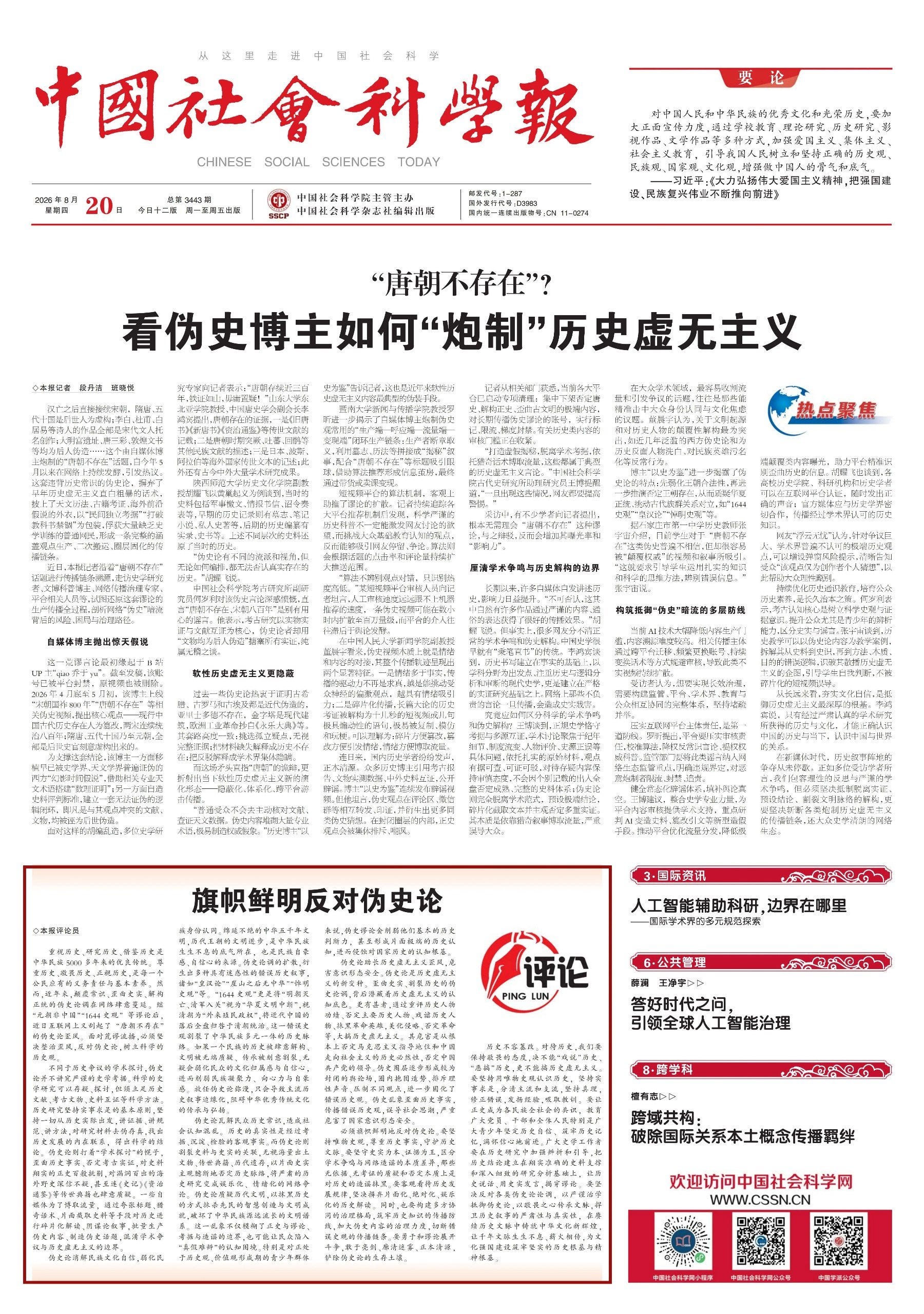
The first article, a reported piece, examined the rise of these theories and dourly insisted on the undeniable existence of the Tang, after which it turned to its major announcement: an internet-wide campaign to censor all content that “denies Tang history, deconstructs official histories and distorts ancient civilization.” The piece also interviewed a censor for an unnamed internet platform who offered a mea culpa for the Tang Truthers’ virality: “The algorithm can’t discern whether opinions are true or false; only whether they’re popular or not.”
The second article, an opinion piece, was far more ominous. It held that Tang Trutherism is “historical nihilism.” What is that exactly? Historical nihilism is a political charge unrelated to the historical rigor of a claim: it is an accusation of an attack on the leadership of the Party-state. It has been used to tar historians, journalists, teachers and even a chef for asking sharp and pertinent questions about the historical record, or in the latter case for sharing a recipe. Sometimes it comes with jail time. Most often, these charges relate to questions of modern Chinese history. So how does joking about the Tang Dynasty have any political salience today? This excerpt from the opinion piece explains:
False theories of history dissolve cultural confidence and weaken national identity. Five thousand years of unbroken Chinese civilization, and the civilizational advances of each successive dynasty, are the ground on which the Chinese nation's vitality rests and a source of pride and self-assurance for its people. The spread of fake history has generated a range of deceptive, incorrect historical narratives — among them "Han supremacism," "after Yashan there is no China," and "mourning-the-Ming.” The "1644 view of history" goes further still, treating the fall of the Ming and the Qing entry through the pass as a "rupture in Chinese civilization,” casting the Qing as an alien colonial regime, and laying the whole of modern China's backwardness at the door of Qing rule. Such a view severs the historical thread that binds the Chinese nation's plurality into unity. When a people's national history is deconstructed at will, its civilization questioned without cause, its inheritance deliberately severed, the inevitable result is a weakened sense of cultural belonging and diminished confidence, and with them a loss of cohesion, common purpose, and pride. To let false theories of history spread unchecked can only marginalize the mainstream historical narrative and obstruct the transmission and promotion of China's excellent traditional culture.
Wait, that has nothing to do with the Tang at all! Why is the op-ed talking about Han supremacy and mourning the Ming (1368-1644)? And weren’t the Qing (1644-1912) foreign invaders? And what the hell does any of that have to do with the Tang?
To understand we must return to the original video the Party blames for setting this trend off and then go further back to understand why 1644 has become such an explosive year in the Party-state’s conception of what China is today.
Qing, Qing, Qing! History is ringing.
The videos the Party-state blames for setting this in motion were posted to Bilibili, a YouTube-like site, by an anonymous user named “qiao乔于yu” in late April and early May of this year. Though the originals have been deleted, a few clips still exist on YouTube. They’re odd, dry affairs. “Qiaoyu,” a disembodied voice, pores over dynastic chronologies discussing tax revenues, mining regulations, customs excises, currency and classical astronomy. He then claims: “The real chronology of China is Han, Six Dynasties, Song and then Ming, this is the real timeline. The Tang and Yuan have been inserted. Our timeline has been altered.”
But it’s what he says next that makes the claim that the Tang and Yuan never existed politically perilous: “The first time we [Chinese] were governed by foreigners on our homeland was the Qing Dynasty. That was the first time ‘the nation perished and the race went extinct’… and it is the only time that has ever happened.” The Qing, he goes on to explain, were a foreign race that enslaved Chinese and colonized China. That history, he alleges, has been covered up.
Qiaoyu’s views align with the “1644 view on history,” a recent ultra-nationalist narrative that China’s humiliation began the year the Ming fell. Since 1644, these nationalists hold, Han Chinese have been discriminated against: first by the Manchu Qing and now due to allegedly preferential treatment for minorities in the modern PRC. Common complaints about reverse discrimination against Han include preferential college admissions, welfare benefits, native-language schooling and, formerly, family planning exemptions for ethnic minorities. The Party-state does not tolerate these narratives in public and, what’s more, denies that the Qing were distinctively Manchu as opposed to Chinese — totally rejecting the American school of historiography called New Qing History that explores Qing identity. In July, The Economist’s Chaguan published an excellent column on the Qing controversies that concluded on an (unintentionally?) prescient observation:
“Nationalists are guilty of over-simplifying Chinese history. Romanticising pre-Qing epochs as pure expressions of Han strength omits that China was a multi-ethnic, even cosmopolitan, entity during one of its most glorious periods, under the Tang dynasty more than a millennium ago.”
Well, the nationalists have found their rebuttal: the Tang simply did not exist. It was a psyop conceived the Qing and maintained by the Party-state to condition Han to accept their subjugation. China has never been multi-ethnic, let alone cosmopolitan. The Han have always ruled China but for the brief humiliation of Manchu domination under the Qing. The People’s Republic of China’s relative ethnic tolerance is thus a betrayal of the five-thousand years of traditional culture it purports to protect. That is how the Han supremacists see it. And that is why the Party-state reacted with such intensity to the seemingly silly claim that the Tang never existed.
Surely most who shared Tang memes did so in jest. But in American terms, the Tang memes were less “birds aren’t real” and more “the moon landing was fake” or “jet fuel can’t melt steel beams.” For the true believers, these claims are an expression of rage against the status quo. And just like moon landing skeptics and 9/11 truthers, yet another official rebuttal will do little to calm them. But I wager a greater tolerance for real research into the Qing history might. The carapace of PRC historiography is fracturing, exposing the hollow narratives within. Real historians can create a more durable structure — or Tang Truthers can tear it all down. ∎
Alex: excellent essay. Thank you! You might also enjoy this, from back in the 2008 Olympic year:
http://www.chinaheritagequarterly.org/articles.php?searchterm=020_zhai_quanan.inc&issue=020
Qing Dynasty was supposedly “fake” and “foreign” (the Manchus are definitely foreign that’s true) but somehow it gives justification for the expansion of Chinese borders
The bad guys also don’t talk about how Dr. Sun hated the Manchus so much he was willing to sell them away: except it became suddenly convenient when he realized he could claim the former Qing’s borders and all the ethnic minorities who were evil became part of the “family of five races under one union,” including the “foreign Manchus”
Hmmmmm
Very good article by the way